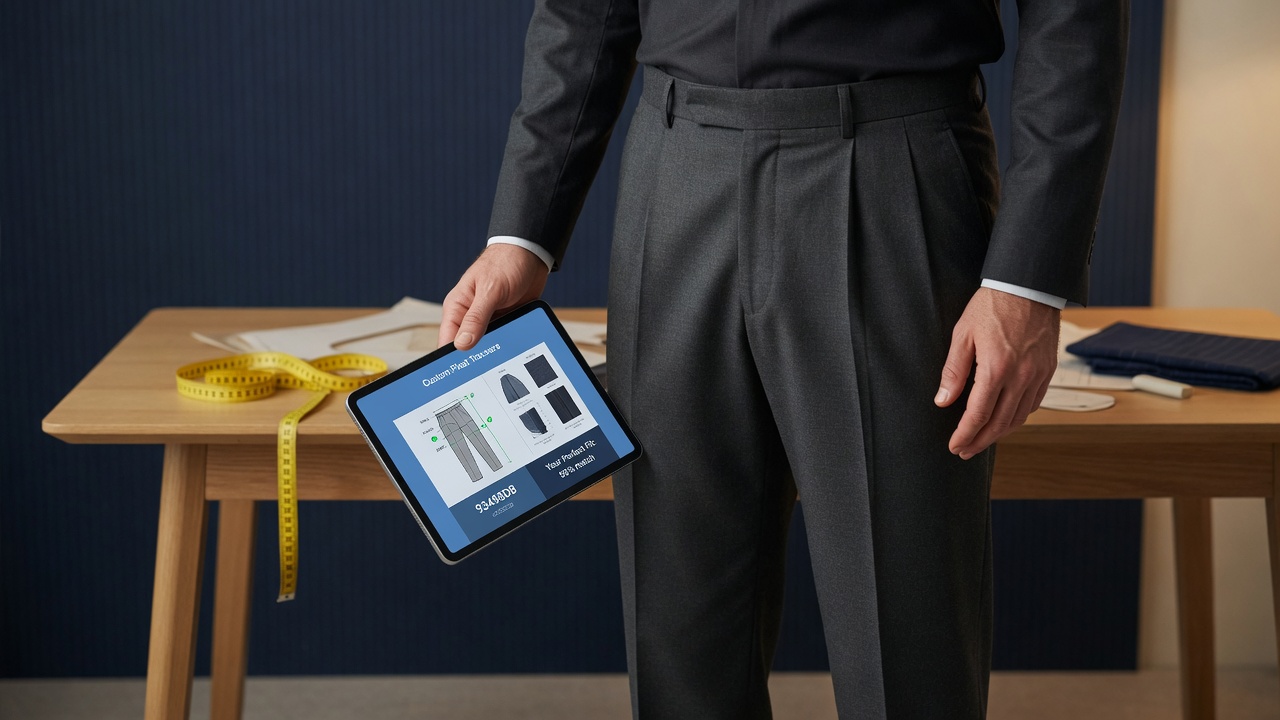
Order Custom Pleat Trousers Online: Your Complete Guide
You know the feeling — a pair of trousers that fits well in the waist but bags at the knees, or sits perfectly standing up but pulls tight when you sit down. Off-the-rack sizing is built for an average body that almost nobody has. The real cost isn’t just the money spent on ill-fitting trousers. It’s the frustration of settling, of dressing around flaws instead of showing off what works. And it’s the hidden assumption that “good fit” is a privilege reserved for expensive brands.
By the end of this guide, you’ll know exactly how to order custom pleat trousers online — from choosing the right style and fabric to getting accurate measurements — so you can finally own trousers that fit your body, not the other way around. We’ll start with the basics of trouser terminology, walk through styles and fabrics, and finish with a step-by-step ordering guide that takes the guesswork out of going custom.
Key Takeaways
Ordering custom pleat trousers online gives you control over fit, fabric, and details — 78% of first-time buyers report satisfaction on their first order when provided with proper measurement guidance.
- Choose the right style — Single pleats suit most body types; double pleats add room through the seat and thigh
- Pick fabric by season — Lightweight wool for year-round wear, linen for summer, flannel for winter
- The Balance Point matters — Custom fitting balances silhouette, comfort, and movement for a perfect pair
What Are Trousers? Understanding the Basics
Trousers are any two-legged garment that hangs from the waist and covers each leg separately — a definition that separates them from shorts, skirts, and leggings. In American English, we call them pants. In British English, trousers covers everything from dress slacks to jeans. Why does this distinction matter for someone ordering custom? Because different services use different terminology. A UK-based tailor lists “trousers” while a US-based service lists “pants” — they mean the same thing, but knowing both terms helps you search more effectively.
A well-fitted trouser starts at the natural waist (not the hips), covers the seat smoothly without pulling, and falls straight down each leg to just above the shoe. The rise — the distance from the crotch seam to the waistband — determines whether the trousers sit at your natural waist or lower on your hips. The inseam — the length from your crotch to your ankle — determines where the hem sits on your shoe. Getting these two measurements right is the foundation of any good custom order.
Once you know what trousers are, the next step is finding a style that works for your body.
A Guide to Trouser Styles: Finding the Right Fit for You
Choosing a trouser style comes down to understanding how different cuts interact with your body type, your daily activities, and the look you want to create. Here’s what you need to know about the most common options.
Pleated Trousers: A Classic Choice
Pleated trousers — which have vertical folds sewn into the waistband that add extra fabric through the hips and thighs — emerged in the early 20th century as a practical innovation for active men, according to the Fashion History Timeline at FIT. The two main types are single forward pleats and single reverse pleats. Forward pleats point toward the pockets and create a cleaner vertical line. Reverse pleats point toward the zipper and offer slightly more room through the seat.
Pleats benefit men with larger thighs, glutes, or anyone who wants more freedom of movement without sizing up at the waist. Consider a man with an athletic build — 32-inch waist with 24-inch thighs. Flat-front trousers in his waist size will feel tight in the leg, but sizing up to accommodate the thighs leaves the waist baggy. Pleats solve this problem beautifully.
If pleats offer maximum comfort and room, the alternative — flat-front trousers — takes a different approach. Here’s how to decide between them.
Flat-Front vs. Pleated: Which Is Right for You?
Flat-front trousers — which have a smooth front panel without pleats — create a sleeker silhouette that works best for slimmer builds and formal settings. They require a closer fit through the hip and thigh, which means less room for movement. Pleated trousers are more forgiving — they allow for movement, accommodate wider hips, and can make a slim waist look even trimmer by adding visual volume below.
Finding your Balance Point between silhouette (how you look) and comfort (how you feel) is what choosing between these two styles is really about. If you’re an office worker who sits eight hours a day, pleats prevent fabric from pulling tight across the thighs. If you have a slim build and spend most of your day standing in meetings, flat-front creates a cleaner, more polished line.
Beyond the pleat decision, the wider world of trouser styles offers options for every preference. Here’s a quick tour of what’s out there.
Other Popular Styles to Know
- Baggy and wide-leg trousers — loose through the entire leg; trending again but suit relaxed, casual settings rather than formal wear
- Slim fit and straight leg — tailored cuts that work well for slimmer builds; straight leg is the most universally flattering shape
- Cargo trousers — practical with pockets but bulkier; best for casual and outdoor wear
Straight leg is the most universally flattering. Slim fit works best if you’re lean. Baggy trousers suit relaxed, casual settings. Each style has its place, but for most first-time custom buyers, pleated or flat-front in a straight or tapered leg is the safest starting point.
Once you’ve settled on a style, the next big decision is fabric. The material determines not just how your trousers look, but how they feel, breathe, and last.
Choosing the Right Fabric for Your Trousers
Your fabric choice affects everything from how the trousers drape to how often you need to clean them. Here’s a breakdown by season and care requirements.
Lightweight Fabrics for Warm Weather
Linen trousers breathe four times more than cotton — making them the best choice for humid summer days, though they wrinkle easily. Embrace the texture as part of the look rather than fighting it. Lightweight cotton options like poplin and seersucker offer a middle ground — breathable but holds a crease better than linen. For a summer wedding, tropical wool in a light grey keeps you cool and crisp through the ceremony and reception. Tropical wool is a lightweight worsted wool that resists wrinkles better than linen while still breathing well in heat.
When the weather cools, heavier fabrics bring warmth, texture, and a more formal silhouette.
Wool and Heavy Fabrics for Cooler Months
Wool trousers are the gold standard for dress trousers — worsted wool drapes beautifully, resists wrinkles, and breathes well for its weight. Flannel is brushed wool with a soft, fuzzy finish that’s warmer and more casual than worsted. Grey flannel trousers are the ultimate cold-weather wardrobe staple — they pair with everything from a blazer to a chunky sweater. Tweed and corduroy add textured visual interest and work best for casual and country-style wear.
No matter which fabric you choose, a little care knowledge goes a long way toward keeping your custom trousers looking their best.
Care Considerations for Different Fabrics
- Wool (worsted, flannel, tweed): dry clean only; store on wide wooden hangers to maintain shape; brush after each wear to remove surface dirt
- Cotton and linen: can be machine washed on gentle cycle, but line drying is best; expect more wrinkles than wool
- Corduroy: wash inside-out to protect the wales (the vertical ridges); avoid fabric softener
The FTC textile labeling guide requires all textile products to disclose fiber content on their labels. When ordering custom trousers, check the fabric composition to confirm what you’re getting — 100% wool behaves differently than a wool-polyester blend.
With your style and fabric decisions made, it’s time to walk through the actual ordering process — step by step.
How to Order Custom Pleat Trousers Online
Most custom trouser services deliver your first pair within 2-4 weeks — with prices ranging from $109 at Hockerty to $800+ at full bespoke tailors. Here’s how the process works from start to finish.
Step 1: Choose Your Custom Trouser Service
Three services stand out for first-time buyers. Hockerty — best for entry-level pricing at $109+; web-based ordering with measurement guides; 2-3 week turnaround. MTailor — uses your smartphone camera to take measurements automatically; $150+ starting price; ideal if you don’t trust yourself with a tape measure. SPOKE — not fully custom but offers 41 size combinations including waist, leg, and thigh dimensions; $120+; great for those who want better fit without the full custom process.
If you want the full custom experience at the lowest entry price, Hockerty is hard to beat. If measuring yourself sounds intimidating, MTailor’s app handles it for you.
With a service picked, the next step is getting your measurements right — the single most important factor in a successful custom order.
Step 2: Getting Accurate Measurements
Key measurements needed include waist, inseam (crotch to ankle bone), outseam (waist to floor), hip, and thigh. Each service provides a measurement guide. Pro tip: measure over properly fitted trousers, not over underwear. Use a cloth tape measure, not a metal one. Measure at the end of the day — your body settles and expands slightly throughout the day, giving you a more accurate daytime fit.
The inseam is the most commonly mis-measured. It should run from your crotch to the bottom of your ankle bone — not to the floor. The Iowa State Extension measurement guide provides step-by-step guidance for all key measurements. NIST body measurement research explores 3D body scanning and standardized sizing methods that are making custom fitting even more precise.
With your measurements submitted, the fun part begins — choosing the fabric, color, and details that make the trousers yours.
Step 3: Select Your Fabric and Style Details
Most services offer 100+ fabric options. Use the fabric guidance from the previous section to narrow your choice by season and formality. Then choose your style details: pleat count (single vs. double), rise height (high, mid, low), leg opening (tapered, straight, wide), pocket style (side pockets, coin pocket, back welt pockets), and closure (button fly vs. zip fly).
The FTC Textile Fiber Products Identification Act requires labels to disclose fiber content, country of origin, and manufacturer identity. When browsing fabric options, look for the composition — % wool, % cotton, % synthetic — to verify quality. If you’re ordering pleated trousers for office wear, a mid-rise with single forward pleats, side pockets, and a tapered leg is a safe, versatile choice.
Once your order is placed, the service crafts your trousers based on your specifications. Here’s what happens next.
Step 4: The Fitting and Revision Process
Most services send a finished garment, not a try-on sample. Premium services sometimes offer a test garment for fit approval first. When your trousers arrive, try them on with the shoes you’ll wear them with. Check three things: the waist is snug but not tight, the seat is smooth without pulling, and the length covers the top of your shoe with a slight break (a gentle fold where the fabric hits your shoe).
The fitting process is where you find your Balance Point — adjusting the pattern until silhouette, comfort, and movement align. Most services offer one free revision if the fit isn’t right. If the waist is perfect but the thighs feel tight, the pattern can be adjusted for your next order without starting from scratch.
If custom ordering isn’t in your immediate plans, the next best thing is finding a ready-to-wear brand that fits well. Here are the top options across price points.
Top Trouser Brands at Every Price Point
- Budget ($30-$80): Uniqlo — Japanese retailer offering minimalist, quality basics. Their smart-looking trousers with stretch fabric are ideal for first-time buyers on a tight budget who still want decent fit.
- Mid-Range ($80-$150): Lululemon — premium athletic-wear brand whose ABC (Anti-Ball Crushing) trousers have become a wardrobe staple for professionals who commute or sit all day. Comfort-focused with impressive durability.
- Premium ($150-$300): Theory — contemporary brand known for clean lines and quality fabrics. Worth the investment if you wear trousers daily and want minimalist design with excellent fabric quality.
- Outdoor/Specialty: Fjallraven — Swedish outdoor brand built for durability. Their Keb trousers are reinforced for hiking and travel, making them best for outdoor use rather than office wear.
Still have questions about ordering custom trousers? Here are answers to the most common ones.
Frequently Asked Questions
How do I measure myself for custom trousers without a tailor?
Measuring for custom trousers is simpler than it sounds. You’ll need a cloth tape measure and a pair of well-fitting trousers as a reference. Measure your waist at the narrowest point, your inseam from crotch to ankle bone, and your outseam from waist to floor. Most custom services provide detailed video guides. Measure twice, order once — and always measure at the end of the day when your body has settled.
Are pleated trousers still in style?
Yes, pleated trousers are very much in style and have been a staple of classic menswear for over a century. The key is choosing the right pleat for your body — single forward pleats for a cleaner look, double pleats for more room. Pleated trousers have seen a major resurgence in recent years as looser, more comfortable fits have returned to fashion. They’re not just acceptable — they’re desirable.
What’s the difference between made-to-measure and bespoke?
Made-to-measure starts with a standard base pattern and adjusts it to your measurements — it’s faster and more affordable ($100-$500). Bespoke creates an entirely new pattern from scratch based on dozens of measurements and multiple fittings — it’s slower and significantly more expensive ($800-$5,000+). For most first-time buyers, made-to-measure offers 90% of the benefit at a fraction of the cost.
Conclusion: Find Your Perfect Fit
For first-time buyers, ordering custom pleat trousers online delivers a fit that off-the-rack simply cannot match. The key is finding your Balance Point — the sweet spot where silhouette, comfort, and movement align for your specific body. Start by choosing a style (pleated for room and movement), a fabric suited to your climate, and a service that fits your budget and comfort level with measuring.
Remember, every pair of trousers is a negotiation between how you want to look and how you need to move. Off-the-rack forces you to compromise. Custom lets you find your Balance Point. That one concept — balancing appearance, feel, and function — transforms the entire trouser shopping experience from a frustration into an investment.
Your next step: Grab a cloth tape measure and a pair of trousers that fit reasonably well. Take your waist and inseam measurements using the Iowa State Extension guide. Then browse Hockerty or MTailor — both offer pleated trouser options starting under $150. Place an order, trust the process, and prepare to experience what “perfect fit” actually feels like.