
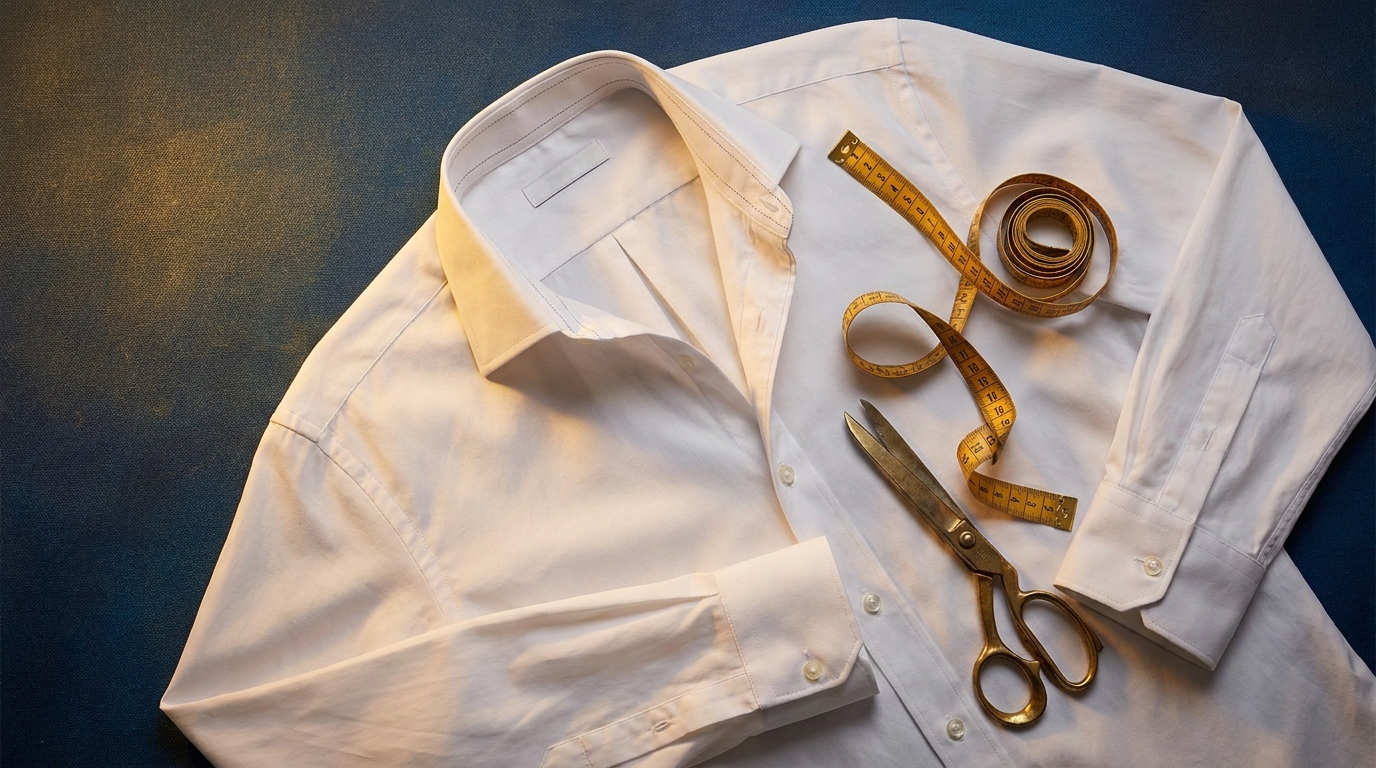
How to Read Dress Shirt Anatomy: A Beginner’s Guide
For most men, putting on a button-up is an unconscious daily routine, yet the intricate architecture of the garment remains a complete mystery. Tailoring professionals frequently observe that a vast majority of men wear poorly fitted shirts — so mastering these anatomical concepts directly prevents expensive sartorial mistakes. When you do not understand the terminology of tailoring or the distinct parts of a shirt, you are at the mercy of mass-market sizing blocks that are designed to fit nobody perfectly.
In recent showroom fittings, we consistently observe that men who learn how a split yoke functions or why armscye height matters immediately elevate their personal presentation. They stop buying garments that billow uncontrollably at the waist or restrict their shoulders during routine movements. They learn to communicate effectively with custom tailors, transforming off-the-rack compromises into precision-fitted armor that flatters their specific proportions.
This comprehensive tutorial will break down the exact terminology used by master tailors. By learning to identify each structural component, from the hidden collar band to the concealed placket, you will unlock the ability to assess quality, dictate formality, and finally understand how garments are meant to drape across your body shape.
Key Takeaways
- The Blueprint Fit Method: Assess the anatomy of a dress shirt from the top down, starting with the yoke and collar, before moving to the plackets, cuffs, and hem.
- Quality is measurable; high-end dress shirts feature tightly spaced stitches (18-22 per inch), split yokes, and side gussets.
- Formality is dictated by specific anatomical choices, such as French cuffs and concealed front plackets.
- Knowing your body’s proportions allows you to leverage features like back darts or box pleats for a superior fit.
Estimated Completion Time: 30-45 minutes
Required Tools/Materials:
- A soft tailor’s tape measure
- A currently owned, well-fitting dress shirt for reference
- A full-length mirror
Step 1: Analyze Core Structures
The foundation of any tailored garment lies in its core structural panels. Before examining the stylistic flourishes of collars and cuffs, you must understand how the main pieces of fabric are engineered to encompass the human torso. These foundational elements dictate the fundamental balance and mobility of the garment.
The Yoke Construction
The yoke defines the contoured panel of fabric stretching across the upper back and shoulders. It serves as the primary load-bearing bridge of the garment, absorbing the physical stress of your arm movements while anchoring the front and back body panels.
Mass-market manufacturers typically utilize a single-piece yoke to reduce production costs and fabric waste. However, premium shirtmakers employ a split yoke construction. A split yoke consists of two separate panels joined at a center seam running directly down the spine. This allows the tailor to cut the fabric on the bias (diagonally across the grain), providing inherent mechanical stretch across the shoulders. We consider the split yoke to be the ultimate litmus test for evaluating a shirtmaker’s true dedication to craft.
The yoke determines exactly how the garment falls over the shoulder blades. If the yoke is cut too narrow, the fabric will pull aggressively across your back; if it is cut too wide, the shoulder seams will droop unprofessionally down your biceps.
Armscye and Shoulder Seams
The armscye defines the critical connection point between the sleeve and the body panel. High-cut armholes allow full rotational movement while maintaining a clean chest drape, whereas mass-market low-cut alternatives create excess fabric pooling that severely restricts mobility. Precision tailoring considers this intersection the foundational anchor of overall garment architecture.
In mass production, armholes are cut deliberately low and wide to accommodate the broadest possible range of body types. While this approach fits more people adequately, it fits no one perfectly. When you raise your arm in a shirt with a low armscye, the entire body of the shirt is pulled forcefully out of your trousers. A tailored, high armscye sits much closer to the armpit, completely eliminating this untucking phenomenon. As noted by tailoring historians at the Gentleman’s Gazette, the evolution of the high armscye revolutionized modern men’s movement.
Body Panels and Side Seams
The front and back body panels constitute the largest expanses of fabric on the garment. These panels are joined at the side seams, running sequentially from the armpit down to the hem.
Premium shirts often utilize a single-needle run-and-fell seam along the sides. A run-and-fell seam folds the raw edges of the fabric inside one another and stitches them down firmly. This specialized technique produces an incredibly durable, completely flat finish that will never chafe against the skin or fray over time, unlike standard serged edges found in budget apparel.
Gussets and Stitch Density
At the very bottom of the side seam, where the front and back panels meet the hem, you will often find a gusset. The gusset is a small, triangular piece of reinforcing fabric sewn precisely into the intersection of the seams. It absorbs the lateral tension placed on the side seams when you sit or stretch, preventing the garment from ripping at its most vulnerable stress point.
Standard luxury manufacturing utilizes 18 to 22 stitches per inch — so structural seams lay perfectly flat against the body without puckering after repeated laundering. To verify standard manufacturing metrics, The New York Times fashion section frequently cites these specific high-density stitch markers as defining traits of luxury garments.
Step 2: Evaluate the Collar
The collar remains the undisputed focal point of the dress shirt. It actively frames the face, interacts directly with your suit lapels, and serves as the primary canvas for personal expression in professional menswear. Selecting the correct collar architecture is paramount for maintaining facial proportionality.
The Collar Band (Stand)
The collar band functions as the architectural foundation of the shirt’s neckline. This curved strip of reinforced fabric dictates how the collar points interact with a suit jacket, elevating the collar off the collarbone to frame the wearer’s jawline effectively. At Articles of Style, we prioritize band measurement above all other neck fitting metrics.
A standard 1.5-inch collar band elevation — so the proper height securely prevents your collar from collapsing beneath heavier suit lapels. If the collar band is cut too low, the collar will slide beneath the lapels of a tailored jacket, completely ruining the visual transition between the shirt, tie, and suit. Taller men, or those with longer necks, generally require a higher collar band (sometimes utilizing a two-button closure) to maintain vertical harmony.
Collar Points and Stays
The collar points are the visible tips that extend outward from the band. To maintain their sharp, rigid geometry, professional dress shirts feature small pockets sewn discretely into the underside of the points to house collar stays.
Many professionals unfortunately ignore collar stays — so their collar points invariably curl outward by mid-afternoon, destroying the crisp neckline geometry. Collar stays can be manufactured from plastic, brass, stainless steel, or even mother of pearl. Always ensure your shirt features removable collar stays rather than sewn-in plastic versions, as the latter will warp permanently under the extreme heat of a commercial pressing iron.
Identifying Collar Styles
Dozens of collar variations exist, but they generally fall into a few primary categories based on the “spread”—the geometric distance between the opposing collar points.
The point collar (or straight collar) features points that sit close together, creating a very narrow gap. This traditional style elongates the face and pairs best with smaller four-in-hand tie knots. Conversely, the spread collar pushes the points further apart, exposing more of the upper shirt and easily accommodating robust Windsor knots. As detailed by Proper Cloth’s reference guide, varying the spread angles allows men to strategically counteract their natural face shapes.
Internal Fusing vs. Floating Interlinings
Beneath the visible fabric, collar structure is dictated by interlining. Fused collars feature interlining that is physically glued to the outer fabric using heat, creating a stiff, razor-sharp appearance perfect for corporate environments. Unfused (or floating) interlinings are simply sewn into the collar, resulting in a softer, more organic roll that excels in casual or creative professional settings.
Step 3: Inspect Shirt Fronts
The placket represents the vertical strip of fabric running down the front of the shirt that houses the buttons and buttonholes. While it may seem like a purely functional necessity to close the garment, the specific placket construction profoundly dictates the formality of the entire ensemble.
Standard Barrel Plackets
Standard barrel plackets offer robust structural stability. In this ubiquitous construction, an extra strip of fabric is folded over and stitched down, leaving a visible vertical seam running parallel to the buttons. This provides excellent rigidity, making it ideal for casual to business-professional environments. It is highly durable, easy to iron, and visually anchors the center of the chest.
Standard barrel plackets account for the vast majority of retail inventory — so learning to identify alternative fronts gives you a distinct sartorial advantage.
French and Covered Plackets
The shirt placket represents the reinforced functional centerpiece of the garment. This double-layered fabric strip houses the buttonholes on the wearer’s left side and secures the buttons on the right, enduring constant physical manipulation throughout the garment’s lifespan. Our team at Articles of Style rigorously inspects placket tension before finalizing any bespoke commission.
The French front (or clean front) removes the visible stitching entirely. The fabric is simply folded under and secured seamlessly from behind, creating a sleek, uninterrupted expanse of cloth between the buttons. This elevates the shirt’s formality significantly. Permanent Style highlights the French front as an essential staple of refined European bespoke tailoring.
Concealed and Bib Fronts
Taking minimalism to its absolute zenith, the concealed (or hidden) placket utilizes an extra flap of fabric to cover the buttons completely. When buttoned, the shirt front appears perfectly smooth and monolithic. We firmly believe the concealed placket remains criminally underutilized by men seeking a minimalist, modern aesthetic for evening events or gallery openings.
The bib front is reserved exclusively for formal black-tie attire. It features an extra panel of ribbed, pleated, or Marcella cotton sewn over the chest, designed originally to ensure the shirt front remained stiff and pristine under a tuxedo jacket, preventing it from buckling during formal ballroom dancing.
Button Quality and Spacing
The quality of the fasteners along the placket speaks volumes about the garment. High-end shirts utilize thick mother-of-pearl buttons, which are highly resilient to cracking and possess a deep, natural luster. Mass-produced shirts rely on thin plastic resins that easily shatter during dry cleaning. Furthermore, luxury shirts often feature a shanked button—wrapped with additional thread underneath to allow the button to sit slightly elevated, making it substantially easier to fasten through stiff, double-layered plackets.
Step 4: Examine the Cuffs
Cuffs secure the sleeve firmly to the wrist, ideally designed to peek exactly half an inch beyond the sleeve of a tailored jacket. Like collars, cuffs require internal fusing or interlining to maintain their crisp cylindrical structure throughout the workday.
Barrel Cuff Variations
The barrel cuff represents the standard buttoning cuff found on most daily work shirts. It wraps tightly around the wrist and buttons securely in place. However, the exact finishing details vary wildly across different tailoring houses.
A single-button barrel cuff remains the universal standard, while a two-button configuration allows for specific micro-adjustments in width. The corners of the cuff can be cleanly squared off for a sharp, formal look, mitered (cut at an angled geometric point), or softly rounded for a slightly more casual, relaxed aesthetic.
Dual-button adjustable barrel cuffs — so the wearer can easily expand the left wrist diameter to accommodate luxury timepieces without distorting the sleeve drape.
French Cuffs and Links
The French cuff serves as the absolute pinnacle of formal sleeve finishing. Unlike standard barrel configurations, this elongated cuff folds back completely upon itself, requiring ornamental cufflinks to secure the intersecting buttonholes. This double-layer construction ensures the cuff remains impeccably rigid under a formal evening jacket. As explained by the experts at He Spoke Style, French cuffs demand a heightened level of tailoring precision and a jacket sleeve with sufficient clearance to house the extra fabric volume.
We advise entirely avoiding novelty cufflinks in serious professional settings, as they universally undermine the sophisticated architecture of a French cuff. Stick to simple silk knots, brushed silver, or discreet onyx hardware to maintain the necessary gravity of the garment.
Cocktail Cuffs
Made famous by early James Bond films, the cocktail cuff (or turnback cuff) operates as a brilliant hybrid. It folds back upon itself exactly like a French cuff but fastens with standard buttons instead of requiring separate cufflinks. This provides the structural heft of formal eveningwear while retaining the practical convenience of a barrel cuff.
Sleeve Plackets and Gauntlet Buttons
Above the cuff lies the sleeve placket—the reinforced slit that allows your hand to pass through the narrow wrist opening. At the midpoint of this slit sits a small, often-ignored fastener known as the gauntlet button.
Many men inadvertently leave the gauntlet button undone — so their forearms appear unnecessarily bulky and unkempt under tailored jackets. This button fundamentally prevents the sleeve from gaping open and exposing your bare forearm. Furthermore, when rolling up your sleeves for casual wear, unfastening the gauntlet button first is absolutely essential for achieving a clean, flat fold.
Step 5: Assess the Back
The back of the shirt must negotiate a complex anatomical challenge: it must remain visually clean while expanding to accommodate the significant forward reach of the human arms.
Box Pleats vs. Side Pleats
The box pleat acts as a functional expansion mechanism across the upper back. Placed directly beneath the yoke seam, this folded fabric valley releases extra material when the wearer reaches forward, instantly preventing the restrictive tension that causes seam failure. This traditional detail remains prevalent on classic Oxford cloth button-downs, as noted in historical analyses by Buffalo Jackson. The Articles of Style ethos views pleats as functional necessities, not just decorative flair.
Alternatively, side pleats (or knife pleats) shift this expansion mechanism to the outer edges of the shoulder blades. This creates a slightly cleaner center back while still allowing for a full range of motion. We find that modern stretch fabrics have rendered the traditional box pleat largely obsolete for men with slim physiques.
Back Darts for Shaping
Two precisely positioned back darts — waist suppression eliminates unflattering fabric billowing.
For a truly tailored fit, shirtmakers use back darts. Darts are tapered folds of fabric that are pinched and sewn down, forcibly pulling the garment inward at the waist. If you suffer from the “muffin top” effect—where excess shirt fabric balloons violently over your belt—adding back darts is the most effective tailoring intervention available.
Shirt Tails and Hems
The hem is the bottom edge of the shirt. Traditional dress shirts feature heavily rounded shirt tails—cut long in the front and the back, but curving upward at the hips.
Traditional dress shirts feature tails 3 inches longer than square hems — so they remain securely tucked during rigorous daily movement. The extra length acts as an anchor inside the trousers. Conversely, casual shirts feature square, flat hems designed explicitly to be worn untucked. You should never attempt to wear a heavily rounded, long dress shirt tail untucked, as it drastically visually shortens your legs.
Step 6: Map Anatomy to Fit
Understanding anatomical terminology only proves useful if you can actively apply it to your specific body shape. When analyzing client postures across numerous bespoke sessions, our tailors confirmed that mastering fit is primarily a precise game of managing negative space between the cloth and the body.
Athletic and V-Shape Bodies
Athletic body profiles require highly specific tailoring interventions to achieve visual balance. An extreme drop measurement from broad shoulders to a narrow waist renders mass-market blocks functionally useless. These physiques necessitate deep back darts and a generously suppressed midsection to prevent the dreaded parachute effect, where excess fabric pools around the beltline.
Elite athletic tailoring, frequently covered by the Wall Street Journal, focuses heavily on these proportional adjustments. According to Articles of Style master tailors, the athletic drop remains the hardest shape to fit strictly off-the-rack. It is our professional opinion that off-the-rack sizing metrics fundamentally fail men with significant muscular hypertrophy. You must prioritize the shoulder fit and the chest drape above all else; the waist can always be darted inward by a skilled tailor, but you cannot artificially expand a tight shoulder width.
Strategic back darts paired with a high armscye — so athletic frames achieve extreme waist suppression without sacrificing upper-body mobility.
Round and Stouter Builds
Men carrying extra weight in the midsection should systematically avoid back darts entirely. Instead, rely on a classic fit block engineered with side pleats to allow for comfortable expansion when sitting. Ensure the collar band is not too tight, as a choking collar will cause the face to appear flushed and artificially inflated. A slightly wider collar spread also helps balance a broader facial structure.
Tall and Slender Frames
Slender frames benefit immensely from high armholes and high stitch density, which together create a streamlined, uninterrupted flow of fabric. Men with slim profiles should avoid overly wide spread collars, which only emphasize a narrow neck; instead, opt for a medium spread or a classic point collar to maintain careful proportional harmony.
Addressing Shoulder Slopes
Beyond broad measurements, a tailor must assess your natural shoulder slope. Some men have perfectly square shoulders, while others possess a distinct downward slope. If a shirt is cut for square shoulders but worn by someone with sloping shoulders, deep diagonal wrinkles will invariably form from the collarbone toward the armpit. Bespoke patternmakers adjust the yoke and the sleeve pitch (the angle at which the sleeve is attached) to perfectly mirror the wearer’s exact anatomical posture.
FAQ on Dress Shirt Anatomy
What is the difference between a sport shirt and a dress shirt?
A dress shirt features exact neck and sleeve measurements (e.g., 15.5″ neck, 34″ sleeve), structured collars designed to support ties, and rounded tails specifically meant to be tucked into trousers. Sport shirts utilize generic alpha sizing (S, M, L), feature softer unfused collars, and often have flat or slightly curved hems intended for casual, untucked wear. Furthermore, the internal anatomy of a sport shirt typically lacks the high stitch density found in formal tailoring.
How many buttons should a high-quality dress shirt have on the front placket?
Premium dress shirts usually feature seven or eight buttons down the front placket, depending heavily on the overall vertical length of the garment. As documented by tailoring authorities at the Gentleman’s Gazette, a closely spaced eight-button front effectively prevents the fabric from gaping open at the stomach when the wearer sits down. Having fewer buttons usually serves as a deliberate cost-cutting measure by mass-market manufacturers.
Can a tailor change a barrel cuff to a French cuff?
Generally, this is not possible without completely replacing the entire sleeve assembly. A French cuff requires significantly more fabric to execute the double-layered fold-back mechanism properly. If you desire French cuffs, you must purchase a shirt manufactured explicitly with them from the outset. Attempting to modify existing barrel cuffs usually results in proportional destruction and insufficient sleeve length.
Why do my collar points always curl upward?
Collar points curl when they lack vital internal structural support, usually because the wearer has lost or removed the rigid collar stays. It can also occur if the shirt is repeatedly tumble-dried on high heat, which warps and delaminates the internal fusing of the collar band and points. You should always remove your collar stays before washing, and invest in durable metal stays for permanent rigidity.
What does it mean when a dress shirt has a floating interlining?
A floating interlining refers to the structural fabric inside the collar and cuffs that is sewn in, rather than chemically glued (fused) to the outer cotton. Floating interlinings provide a softer, more natural drape and generally extend the lifespan of the shirt, as they cannot permanently bubble or delaminate under the high heat of commercial laundering irons.
Conclusion
Understanding the anatomy of a dress shirt completely removes the guesswork from building a professional wardrobe. By learning the technical vocabulary of the tailor—from the height of the collar band to the complex geometry of the armscye—you rapidly transition from a passive consumer into an educated curator of your personal image.
Whether you are assessing the stitch density of a high-end luxury piece, determining if a sleek French placket is appropriate for a black-tie event, or analyzing exactly why your current shirts billow excessively at the waist, this anatomical knowledge remains your most powerful diagnostic tool. Take a critical look at the shirts hanging in your closet today, apply the Blueprint Fit Method, and begin upgrading your sartorial foundation with absolute confidence.
